EVENT
EXPERIENCE
SYSTEM
Different events.
One reusable way through them.
I developed a shared UX framework for A3 events— creating consistent navigation, information architecture and reusable interaction patterns without forcing every event into the same identity.
Reuse the UX decisions. Change the event experience.
Consistent wayfinding.
Attendees encounter familiar navigation and information patterns from one event to another.
Flexible page architecture.
Events can emphasize different content and priorities without rebuilding the entire UX every time.
Distinct identities.
The system creates consistency where users need it while leaving room for each event to feel like itself.
Event pages aren't just landing pages. People actually have to use them.
A3 events range from executive strategy forums to technical safety conferences and emerging-technology programs.
The subjects and audiences change, but attendees repeatedly need to answer the same questions: Why should I attend? What's on the agenda? Who is speaking? What does it cost? Where do I stay? How do I register?
Instead of solving those interaction problems again for every conference, I began treating A3's event experiences as parts of one reusable system.
The event changes. The questions people arrive with don't.
Events get complicated quickly.
Agendas, speakers, pricing, logistics, sponsors, travel and resources create dense information environments.
Visitors arrive with different goals.
Someone deciding whether to attend needs something different from someone returning to find a session, hotel or registration detail.
Every event still needs personality.
Standardizing everything visually would make the system easier to maintain while making the events themselves less meaningful.
Standardize the structure.
Not the personality.
Give the event its own navigation layer.
Once an event contains agendas, speakers, registration, travel, resources and supporting content, it behaves more like a small website than a landing page. The navigation needed to reflect that reality.

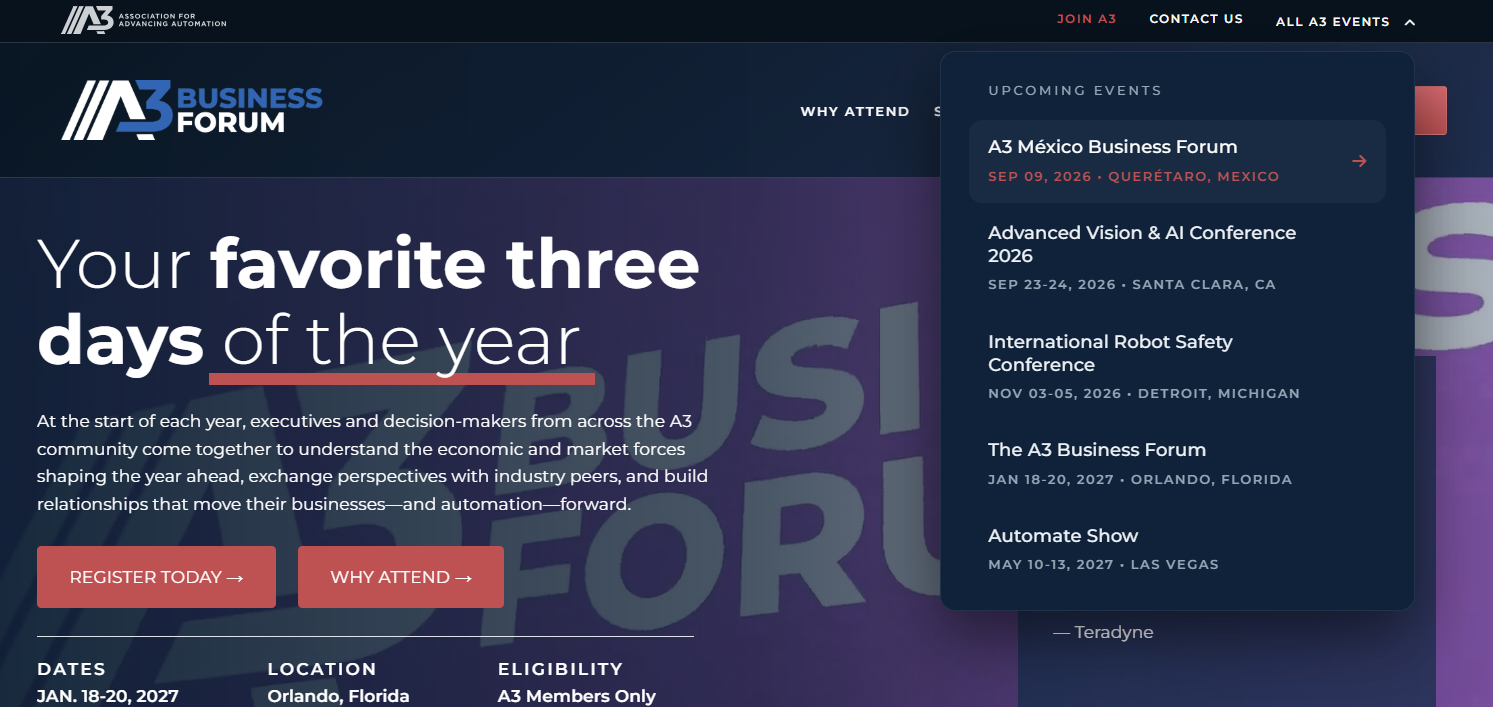
Organize around attendee questions.
Instead of allowing the site's structure to mirror whatever content happened to exist, I organized the experience around the decisions attendees were trying to make.
Why is this worth my time?
Benefits, audience fit, outcomes and the value someone can bring back to their organization.
What will I actually learn?
Sessions, tracks, themes and the practical structure of the event.
Who will I hear from?
Expertise, credibility and the people shaping the conversation.
What does it cost?
Pricing, timing and registration options surfaced without unnecessary friction.
How do I plan for it?
Hotel, location and logistics treated as part of the user experience.
What happens beyond the event?
Standards, training, webinars, articles and tools extend the value beyond attendance.
Different tasks need different page structures.
IRSC shows how the framework extends beyond a homepage. A Why Attend experience supports the decision to register, while Resources creates a more durable destination for safety standards, education and related information.


Shared logic.
Different experiences.
The shared framework defines the invisible parts: navigation, hierarchy and interaction patterns. The content, visual language and emphasis can then respond to each audience.
A3 Business Forum
An executive-focused experience centered on industry strategy, relationships, speakers, venue and a highly curated agenda.
VIEW LIVE EVENT ↗
International Robot Safety Conference
A denser educational experience built around practical safety guidance, standards, expert knowledge and professional roles.
VIEW LIVE EVENT ↗
Advanced Vision + AI
A technical event experience designed to make an emerging subject easier to evaluate through clearer value, deployment context and distinct learning tracks.
VIEW LIVE EVENT ↗
Reuse the thinking. Adapt the expression.
Familiar wayfinding.
Attendees can learn where to find agendas, speakers, travel and registration without relearning the site's structure for every conference.
Flexible hierarchy.
Shared patterns provide structure without forcing every event to contain the same sections in the same order.
Stronger event identity.
Business Forum, IRSC and Advanced Vision + AI can each maintain a distinct visual and editorial tone within one recognizable A3 ecosystem.
Less reinvention.
Reusable UX patterns shift effort away from rebuilding basic interactions and toward solving the communication problem unique to each event.
Design systems aren't about
making everything look the same.
They're about deciding what shouldn't need to be solved twice.
Once navigation, recurring attendee needs and core interaction patterns became shared decisions, each event could spend more of its design energy on the things that actually made it different.
BETHANY
HODGE
DIGITAL EXPERIENCE + DESIGN
UX, web design, information architecture,
design systems and creative direction.
Ann Arbor, Michigan.